Address
304 North Cardinal
St. Dorchester Center, MA 02124
Work Hours
Monday to Friday: 7AM - 7PM
Weekend: 10AM - 5PM
Address
304 North Cardinal
St. Dorchester Center, MA 02124
Work Hours
Monday to Friday: 7AM - 7PM
Weekend: 10AM - 5PM
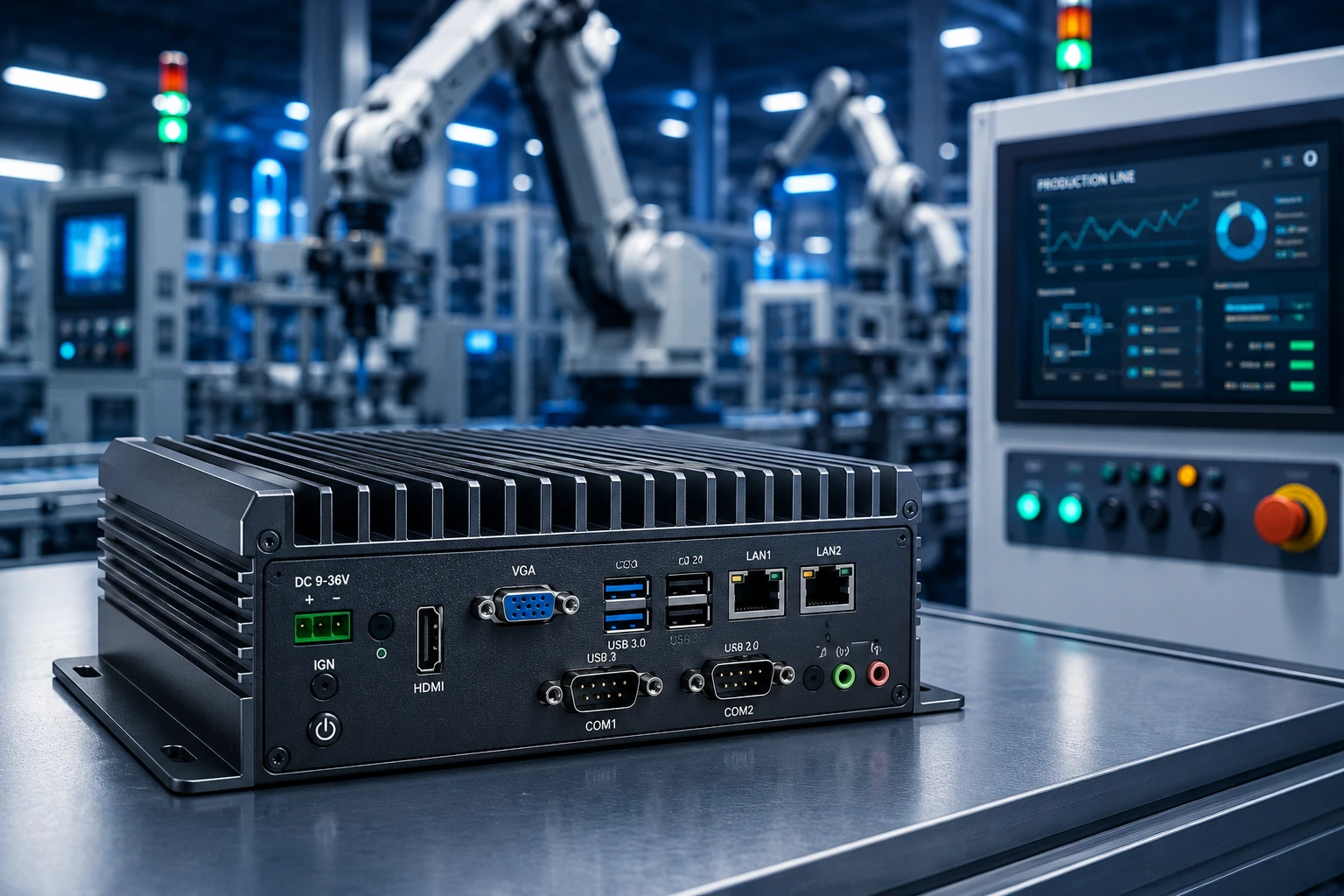
As industrial automation, smart manufacturing, and Industrial IoT continue to evolve, businesses are demanding computing solutions that offer greater reliability, longer service life, and lower maintenance costs.
Traditional industrial computers often rely on cooling fans to dissipate heat. While effective in certain environments, fans introduce moving parts that can wear out over time, collect dust, and increase the risk of system failure.
As a result, fanless industrial PCs have become the preferred choice across a wide range of industries. Their rugged design, silent operation, and superior reliability make them ideal for modern industrial applications.
In this article, we explore why fanless industrial PCs are rapidly becoming the industry standard.
A fanless industrial PC is a computer designed without mechanical cooling fans.
Instead of using active cooling, these systems utilize:
Heat generated by internal components is transferred directly to the enclosure, where it is naturally dissipated into the surrounding environment.
This design eliminates one of the most common failure points found in traditional computers.
Reliability is one of the primary reasons manufacturers choose fanless industrial computers.
Cooling fans are mechanical components that experience wear and tear over time.
Common fan-related issues include:
By eliminating fans entirely, industrial PCs become significantly more reliable.
For applications requiring 24/7 operation, reliability is critical.
Many industrial facilities contain large amounts of airborne particles.
Examples include:
Traditional fans continuously pull dust into the system.
Over time, dust accumulation can cause:
Fanless systems use sealed designs that help prevent contaminants from entering the computer.
This makes them ideal for harsh industrial environments.
Maintenance expenses can quickly increase in large-scale manufacturing operations.
Traditional fan-cooled systems often require:
Fanless industrial PCs significantly reduce these maintenance requirements.
Over the system lifecycle, these savings can be substantial.
Noise reduction is becoming increasingly important in modern workplaces.
Because fanless industrial PCs have no moving cooling components, they operate silently.
This is especially beneficial in:
Silent operation contributes to a more comfortable working environment while maintaining industrial-grade performance.
Industrial equipment is often exposed to constant vibration and mechanical stress.
Applications include:
Cooling fans can be vulnerable to vibration-related failures.
Fanless systems eliminate this risk and offer enhanced durability.
Their rugged construction makes them suitable for demanding industrial environments.
Modern fanless industrial PCs use advanced thermal engineering to maintain stable operating temperatures.
Features may include:
These technologies enable efficient heat dissipation without requiring active cooling.
As processor efficiency continues to improve, fanless designs are capable of supporting increasingly powerful computing workloads.
Industrial IoT (IIoT) and edge computing applications require reliable local processing capabilities.
Fanless industrial PCs are commonly used as edge computing devices because they offer:
Typical edge computing tasks include:
Their reliability makes them a preferred platform for distributed industrial networks.
Energy efficiency is becoming a major consideration for manufacturers worldwide.
Fanless systems generally consume less power than fan-cooled alternatives because they eliminate the energy required to operate cooling fans.
Benefits include:
These advantages align well with modern green manufacturing initiatives.
Without cooling fans, industrial PC manufacturers have greater flexibility when designing system enclosures.
This allows for:
Compact fanless computers are ideal for:
As Industry 4.0 technologies continue to advance, businesses require computing platforms that can support future expansion.
Fanless industrial PCs are increasingly equipped with:
This combination of performance and reliability makes them a future-ready solution for industrial digital transformation.
Fanless industrial computers are widely deployed in:

